
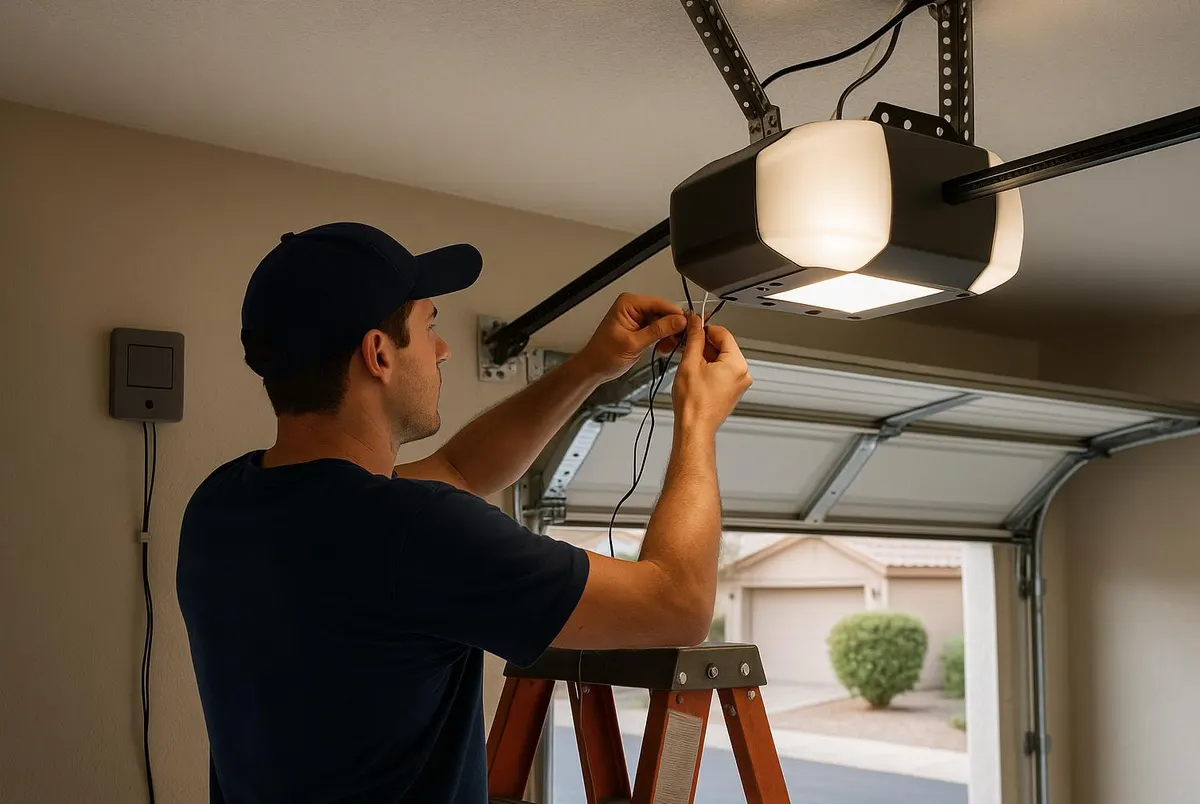
Rule of thumb: if your garage door reverses before it touches the floor, or slams down instead of sealing gently, the fix is almost never "turn up the force" — it's almost always the travel limits, the sensors, or something mechanical the opener is fighting against. The exceptions are real, though: sometimes the opener genuinely is underpowered for a heavier door, and sometimes cold weather is masking a spring problem that looks like a settings problem. Here's how to tell the difference before anyone touches that dial.
What force and travel limits actually are
Every garage door opener has two separate adjustments, and people mix them up constantly:
- Travel limits tell the opener where "fully open" and "fully closed" are. If the limit is set wrong, the door stops short of the floor, slams into the floor, or reverses off the ground when it thinks it's hit an obstruction.
- Force settings tell the opener how much resistance to push through before it assumes something is blocking the door and reverses for safety. This is the setting most people touch when the door "won't close" — and it's the one that causes damage when set too high.
These two settings work together. If the travel limit is wrong, the door is fighting to reach a stopping point that doesn't match reality. If you respond by raising the force instead of fixing the travel limit, the opener just pushes harder against the wrong problem.
Why "just turn up the force" is the wrong fix
This is usually where the argument starts: the door reverses, stutters, or won't seal, and the quickest response is cranking the force dial until it stops complaining. It often works — for a while. Here's the cost:
- The safety reversal stops working the way it should. Federal safety standards exist because openers are required to reverse on light contact — a toy, a pet, a kid's foot. Set the force too high and the door may not stop in time.
- Panels take the abuse. On older sectional doors — common in this area's older housing stock — excess force pushing against a slightly misaligned track or a stiff hinge shows up as dents, cracked panels, or a bowed bottom section over time.
- The opener's drive train wears faster. Gears, belts, and the trolley carriage are rated for a certain load. Running them at max force to compensate for a mechanical issue burns through them months or years ahead of schedule.
- It hides the real problem. If the door needs more force to close, something is usually wrong — unbalanced springs, a dragging roller, a track that's slightly bent from a winter freeze-thaw cycle — and turning up the force just papers over it until it fails harder, later, usually in January.
The exceptions worth knowing
There are a couple of legitimate reasons to adjust force upward, and knowing them settles most arguments fast:
- You recently added insulation or a heavier panel. A retrofit insulation kit or a panel replacement with a different material can genuinely add weight the opener wasn't calibrated for. A modest force adjustment here is normal and expected.
- Cold has stiffened the door, not broken the opener. In freezing weather, nylon rollers and old weatherstripping can stiffen enough that the door needs a touch more push to get moving. If the force problem only shows up on the coldest mornings and goes away by afternoon, that's a strong clue it's the door's resistance, not the opener's calibration.
How this plays out through a Cumberland Valley winter
Snowy, icy winters with repeated freeze-thaw cycles are tough on garage doors in ways that mimic opener problems. Salt spray and runoff corrode track hardware. Moisture gets into weatherstripping and seals, then freezes overnight, gluing the bottom of the door to the slab. In the morning, the opener has to break that ice seal before it can lift the door at all — which can trip the force sensors and look exactly like a settings malfunction. If you're cranking the force dial every December and backing it off every June, that seasonal pattern is the real diagnosis, not the dial.
Humid summers bring the opposite issue: wood expands, tracks can shift slightly with humidity, and torsion springs that were fine in dry weather feel heavier. None of this is fixed by force settings — it's fixed by maintenance, lubrication, and occasionally a spring adjustment.
How to check your settings safely
- Watch the door complete a full open-close cycle without touching anything. Note exactly where it starts reversing or where it slams.
- Place a 2x4 flat on the ground where the door closes. If the door reverses on contact, the safety reversal is working correctly — don't raise the force to defeat this test.
- Check that the photo-eye sensors near the bottom of the tracks are aligned and the lenses are clean. Misaligned sensors cause reversal problems that have nothing to do with force or travel settings.
- If the door still won't close reliably after sensors check out, the travel limit — not the force — is almost always the next adjustment, and it's easy to overcorrect without the right reference points.
When to call Carlisle Garage Door Pro
If you've ruled out dirty sensors and the door still slams, stalls, or reverses unpredictably — especially if it got worse the same week it got cold — that's the point to stop guessing. We handle garage door opener repair and installation and can recalibrate force and travel limits correctly, and if the real cause turns out to be a worn spring or a bent track section, our spring replacement and maintenance visits fix the root problem instead of masking it with a dial.
If your opener's been fighting your door all fall, let's settle it properly before the first hard freeze. Call Carlisle Garage Door Pro — serving Carlisle, Mechanicsburg, Camp Hill, and the surrounding Cumberland Valley — for a straightforward diagnosis and an honest fix.